Career & Status / Case study
Fouquet and the King: What Happens When You Outshine the Boss
In 1661 Nicolas Fouquet threw a dazzling party for Louis XIV and was arrested soon after. What it teaches an employee who outshines a boss.
TrainsPerception Rules · Integrity Compounds · Calm Is Power
Nobody tells you this when you start: your boss is watching how your success makes him look. A boss does not need to be a king to feel small beside a bright subordinate. You will see the pattern in almost every office: the team lead whose deck gets more praise than the director's, the new hire the client cheers while the manager sits quiet. Fouquet's story is the extreme version, and extremes make patterns easy to see.
Here is the rule I take from it. Never let your light cost the person above you their seat. Shine, but share the stage. That is the whole case in one line, and the rest is detail.
DiagramShare the stage
- Stage. Centre the win on the boss's goals, not only on your own.
- Credit. Name what their guidance added, in front of others.
- Show. Keep your best display for the right audience, and keep your results visible.
- Options. Build allies elsewhere, in case the boss still blocks you.
Four moves. Shine, but let the person above you share the light.
What happened
1. The vacancy. In 1661, Cardinal Mazarin, the chief minister of France, died. Many expected the young Louis XIV to name a new one. Louis did not. He chose to rule without that post. Fouquet, who ran the finances and had hoped to rise, now faced a king who intended to hold all the power himself.
2. The man and his taste. Fouquet was rich, cultured and generous. He supported writers and artists and loved fine things. Greene says he sensed that he was losing favour. His answer was to throw a party for the king at his new chateau, Vaux-le-Vicomte.
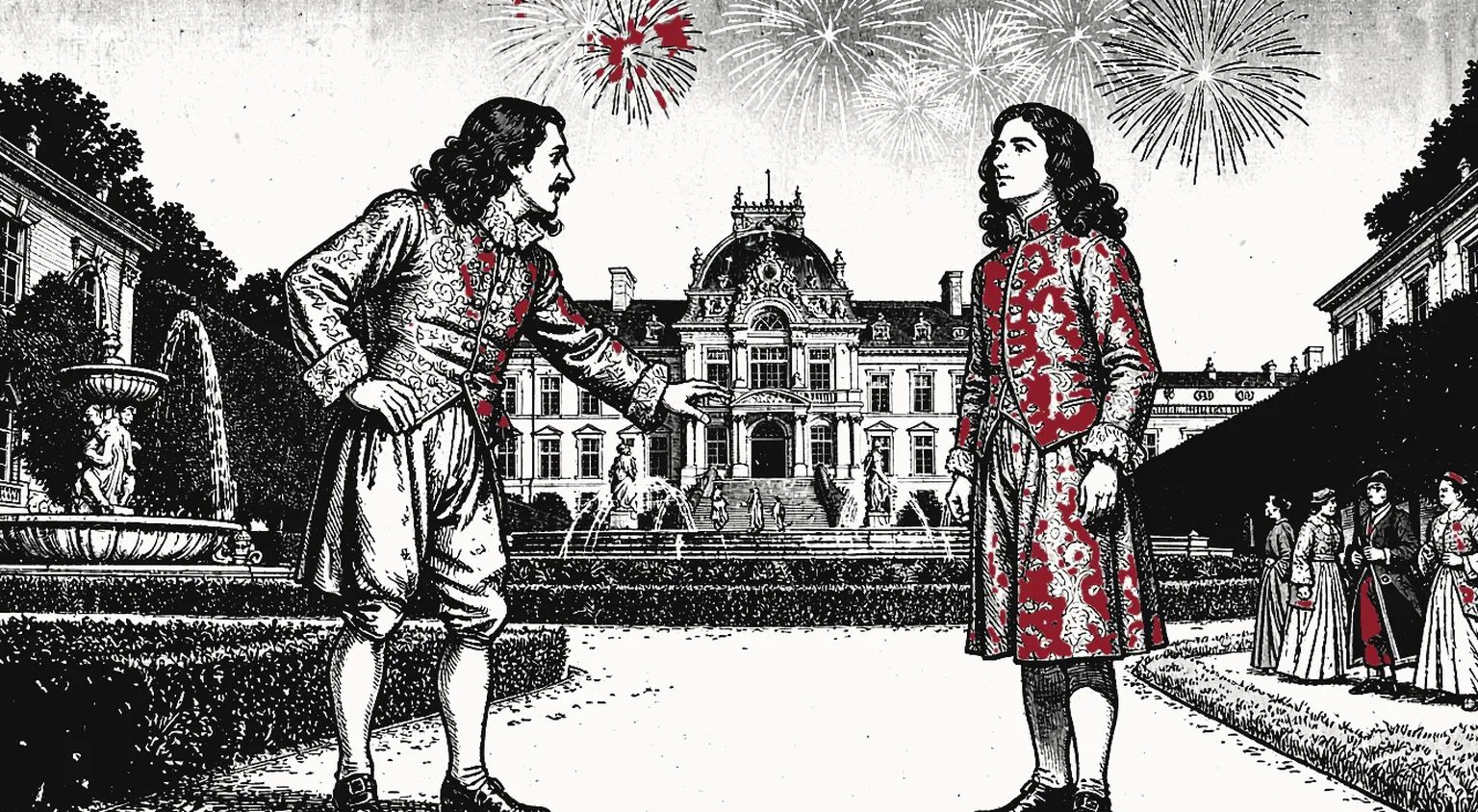
3. The party. By Greene's account, the guests included La Fontaine, La Rochefoucauld and Madame de Sévigné. Molière wrote a play for the evening and acted in it. There was a rich dinner with foods that France had hardly tasted, music written in the king's honour, a walk through the gardens, and fireworks over the canals. People called it the most splendid party they had seen. The public record adds that the chateau itself was a showpiece, built by the architect Le Vau, the painter Le Brun and the garden designer Le Nôtre.
4. The fall. Soon after, the king's chief musketeer, D'Artagnan, arrested Fouquet. Greene's retelling places this the next day. Other accounts place it a few weeks later, in September of the same year, in the city of Nantes. We are not sure of the exact gap, so treat "soon after" as the safe reading. Fouquet was tried for theft from the treasury. Greene says that much of what he did was done for the crown, with the king's leave. He spent the rest of his life, close to twenty years, in prison in the mountains.
5. The replacement. The new finance minister was Colbert, known for being careful with money and dull at parties. Louis then built Versailles with the same architects, decorators and garden designer who had made Vaux-le-Vicomte.
The move
Fouquet's move was an attempt to win favour by showing loyalty, and it was a good attempt. The party was meant to honour the king. But Greene's reading is that each guest's smile at Fouquet told Louis that his own court loved the minister more than the king.
That is Perception Rules at work. The question was never what Fouquet meant. It was what the king saw: a subject with a grander house, a warmer court and finer taste than his own. A person with power over you reads your success in terms of what it says about them.
Be careful with the certainty here. Greene reads the mind of a king who died centuries ago, and his reading is a story, not a record. Historians also point to other reasons for the arrest, such as the king's wish to take control of the finances and Colbert's pressure against Fouquet. I think the "he outshone the king" part is probably true as one factor, not the only one. Greene is right about the mechanism and too neat about the cause. Notice what happened: a splendid evening became evidence, and the king was the judge.
The cost
The cost was total: office, fortune and freedom. Fouquet lost all of it, and the king took the architects and the style he had admired. Even the one thing Fouquet did well was taken and used by the person who fell behind.
Greene's other examples in the same chapter follow the pattern. Galileo, by contrast, gave his discovery of the moons of Jupiter to the Medici family and tied it to their emblem, and was rewarded with a court post. Same skill, different handling.
The counter
What could Fouquet have done differently? Greene's lesson is that he should have made the king shine. A few options:
- Stage the success around the boss. The party could have centred on the king's own achievements, with Fouquet as a quiet host.
- Show less. Keep the grandest house and the largest court for private use, and give the king a plain welcome.
- Spread the credit. Present the work as the king's project.
Greene himself notes the limits of the law. If the superior is a falling star, you need not fear outshining him. And the book's examples are kings and emperors, who are much more fragile and dangerous than a normal manager. A modern boss can usually only block a promotion, not jail you. That is why the question in a modern office is not "hide your talent," but "how do I show it in a way that helps my boss and me?"
What would you do?
Imagine you are Aiko, a senior analyst. Your idea for the quarter's biggest account has made the client enthusiastic, and the client has started to email you directly, not your manager, Pete. Pete has gone quiet in meetings. You have two options: slow down and let Pete take the lead, or keep going and hope the results speak.
Our answer: neither. She should share the credit and the stage on purpose. Aiko sends Pete a short note saying the client's response is partly thanks to his earlier guidance. Copy him on the client emails. Ask him to present the next milestone with you at his side. In private, ask Pete what he needs to look good. You keep your results and your reputation, and he has less reason to see you as a threat. If Pete still blocks you after that, you have learned something useful, and you can keep your options open by building allies and a case elsewhere.
Your callTry a new case
Your presentation to the client went very well. The client says in front of everyone, "This is the best proposal we have seen." Your manager is sitting next to you, silent.
Weaker move. Lever 6 is missing. You let the room decide the story is yours alone, and your manager may read it as being left out.
Strongest move. Lever 6 and Lever 9. You shape what the room sees, share the stage on purpose, and keep your results on record.
Weaker move. Lever 6 is missing. Hiding the result costs you the credit, and your manager still notices the silence.
Lever score
| Lever | Verdict | Why |
|---|---|---|
| 6 Perception Rules | Used, then it backfired | Fouquet built a grand picture of himself, and the king read it as a threat. |
| 1 Calm Is Power | Missed | Facing the fear of losing favour, he acted out of worry and staged a big display. |
| 9 Integrity Compounds | Unclear | His wealth and patronage were real, but the charges against him were the king's choice. We do not know all the facts. |
| 7 Go Around, Not Through | Missed | He could have let the king take the credit. |
For more on how to balance showing your work and being safe, read power at work and office politics. To see how this case fits the book, read our 48 Laws of Power review.
Sources
- Robert Greene, The 48 Laws of Power, Law 1, "Never Outshine the Master" (the main source for the party, the guests and the arrest, and for the reading of the king's thoughts).
- Public historical record on Nicolas Fouquet, the chateau of Vaux-le-Vicomte, and the reign of Louis XIV (for the date of 1661, the architects and the arrest at Nantes). We recommend checking a standard history of the reign for the timing of the arrest and the trial.
Sources: The 48 Laws of Power. Ideas summarised in our own words.
This page trains Lever 6: Perception Rules. People react to how strong you look, not how strong you are.
Also: Integrity Compounds, Calm Is Power.
Next lever: Go Around, Not Through
Find your weakest lever
12 questions, 2 minutes. You get your type and the one lever to train first.
Take the Influence Score