Career & Status / Case study
The Invisible High Performer: Why Great Work Gets Overlooked
A composite story of a skilled analyst passed over for promotion, and the three changes that made her work seen, trusted and wanted.
TrainsPerception Rules · Warm + Strong · Keep Your Options
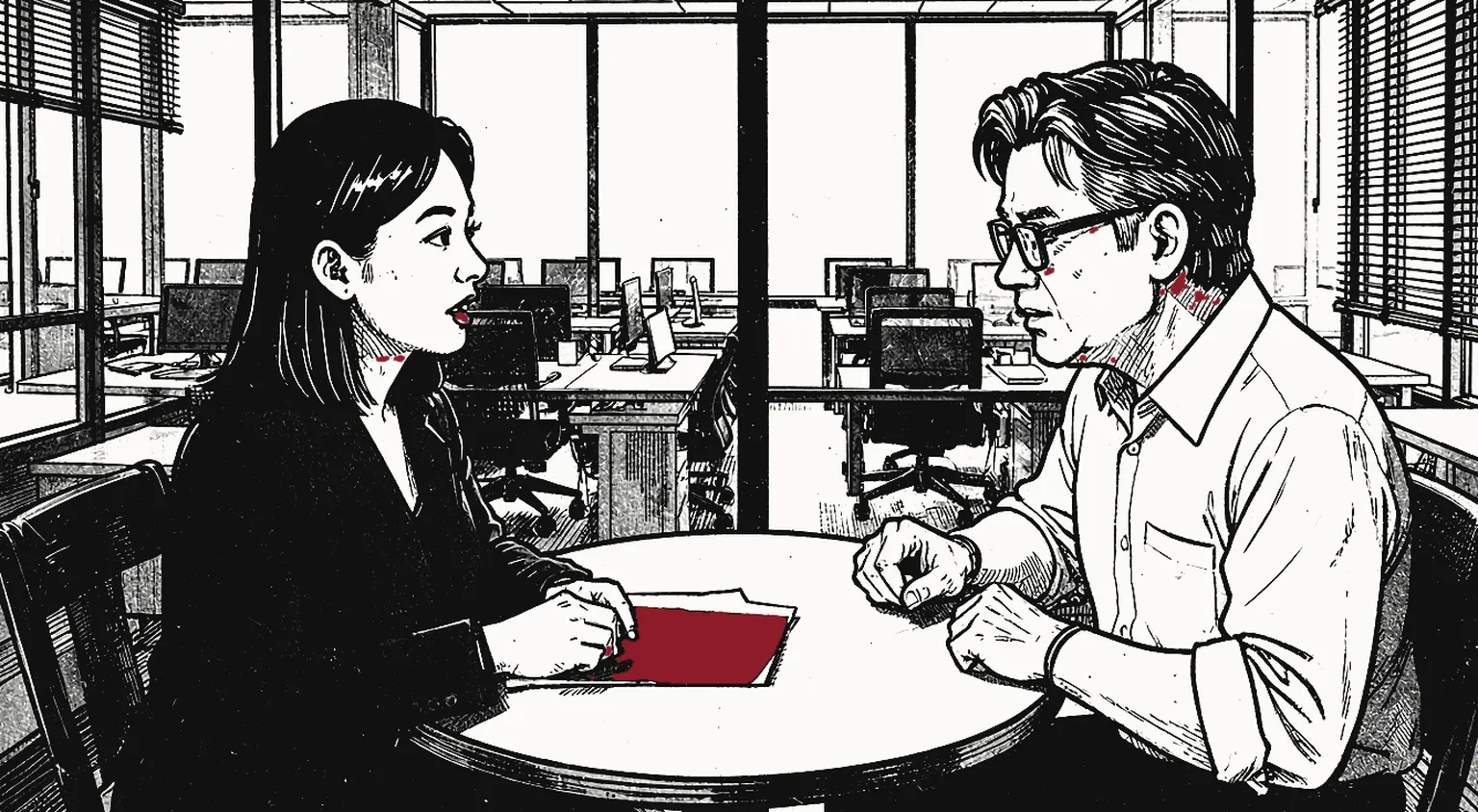
Here is the uncomfortable truth about good work: it does not speak for itself. It sits in a folder until somebody with a voice picks it up. If that somebody is not you, someone else gets the credit. Lina's story is a clean example, because nothing about her skill was missing.
DiagramLina's three changes
Three changes. Her skill and her personality stayed the same.
What happened
1. The best work in the room. Lina has spent six years at the company. Her forecasting models save the warehouse team real money. Colleagues often ask her to check their numbers. She never says no, and she never sends a summary of what she has done.
2. The meeting habit. In meetings she waits until she is sure, and by the time she is sure the topic has moved. When she does speak, she hedges: "This might be wrong, but maybe..." Her face is tense and her voice drops at the end of sentences.
3. The promotion. A team lead role opens. The new director, Omar, asks around. People say Lina is "solid." He promotes Karl, a colleague with the same years of service and a weaker record, who presents loudly and often.
4. The feedback. Lina asks Omar for honest feedback. He says: "You are reliable. I did not see you leading." She is angry, and then she is curious. She has to admit that the picture he holds of her is the one she gave him.
5. The reset. She decides to change three things. She does not change her skill or her personality.
The move
Lina's reset follows three of our levers.
First, make the work visible (Perception Rules). Newport argues that the way to a great career is rare and valuable skill, which he calls career capital. Lina had plenty. What she lacked was a way for the people who decide to see it. So she started a monthly one-page note, four lines long: what she delivered, the effect in money or time, what she was working on next, and where she needed help. She sent it to Omar and two other leaders. No adjectives, only facts.
She also did one thing Newport would call a little bet. She picked a visible, small problem, late shipment forecasts, and ran a short test with the warehouse team. When it worked, she showed the result at the quarterly review. People talked about it, which is what Newport means by a project worth remarking on.
Second, change what the body says (Warm + Strong). Cabane argues in The Charisma Myth that power and warmth are shown mostly by how you act, and that tension in the body is read by others as a signal about them. Lina worked on four plain habits:
- She spoke early in meetings, with one clear sentence.
- She dropped the "this might be wrong" opener and said what she knew and what she did not.
- She slowed down and let her voice end firmly.
- She listened with full attention, which Cabane links to presence.
She also kept her warmth. When someone else made a good point, she said so by name. That mix, firm and generous, is what made her look like a leader, not a rival.
Third, stop being the free helper (Keep Your Options). Because she could not say no, Lina was available to everyone and valued by no one. Newport's idea of control as the thing you buy with capital fits here. She began to say: "I can do that after the forecast review on Thursday. Which is the higher priority?" People learned that her time had a price. She also began to talk to a recruiter and to leaders in another department. She did not plan to leave. She wanted to know that she could.
The cost
Visibility is not free. Lina spent about two hours a month on her notes and her prep. She felt exposed the first few times she spoke firmly in meetings, and she felt a little silly writing her own results down. Some colleagues, used to a quiet helper, were annoyed when she began to say no. One of them cooled toward her for a few weeks.
Her saying no also cost her some goodwill, and she had to decide it was worth it. I think that trade is nearly always right, but it is a trade.
The counter
What could the other side do? Omar could still prefer Karl, because he likes his style or because the decision was political. Karl might feel threatened as Lina's name began to travel, and try to dim her. A boss who values a quiet worker as a free resource may resist the change.
Cabane offers a useful tool for envy: give others ownership of your success. Her JALIR method (justification, appreciation, impact and responsibility) is a way to explain a win so that others feel included rather than beaten. Lina used a lighter form of it. When her forecast project worked, she thanked the warehouse lead by name and said how his team's data made it possible. Karl, in a meeting, lost the chance to mock her win, because the credit was shared.
If the boss still blocks you after all this, Newport's point is that great work comes with control, and an employer that refuses it can be left. That is why the third change mattered. She did not need Omar to say yes.
What would you do?
Picture yourself as Lina in the month after Karl's promotion. You are hurt. Your friends say you should confront the director, or quit, or wait it out. Which path would you pick?
Our answer: none of the three, yet. First change what Omar can see. Spend ninety days making the work visible, speaking with a firm voice and setting a price on your time. After that, ask him directly what he needs to see. If the answer is fair, you have a path. If it is vague, or it keeps changing, you have your answer, and your options will be ready. Quit last, and only with a plan.
Your callWhat would you do?
You are in Lina's place, two weeks after the promotion went to Karl. A friend says, "Go to the director and tell him it was unfair."
Weaker move. Lever 6 is missed. You argue about the past, and Omar still holds the same picture of you.
Weaker move. Lever 6 is the problem. Good work that nobody connects to you keeps you invisible.
Strongest move. Lever 6 and Lever 8. You change what he can see, and you ask for a fair standard while your other options stay open.
Lever score
| Lever | Verdict | Why |
|---|---|---|
| 6 Perception Rules | Missed, then used | For six years the picture was left to chance. Then she fed it with facts. |
| 5 Warm + Strong | Missed, then used | She was warm and weak. She added the strength without losing the warmth. |
| 8 Keep Your Options | Missed, then used | She was needed by all and needed nobody. She built a second route. |
| 1 Calm Is Power | Used | Her reaction to the bad news was curiosity, not anger. |
For the wider map of how respect and influence work in an office, read power at work and office politics. If your next step is a pay talk, see how to ask for a raise.
Sources
- Cal Newport, So Good They Can't Ignore You: career capital, control, little bets and the law of remarkability.
- Olivia Fox Cabane, The Charisma Myth: presence, power and warmth, emotional signals in the body, and the JALIR sequence.
- The story of Lina is a composite built for teaching. It is not a record of a real person, and its results are illustrations, not data.
Sources: So Good They Can't Ignore You; The Charisma Myth. Ideas summarised in our own words.
This page trains Lever 6: Perception Rules. People react to how strong you look, not how strong you are.
Also: Warm + Strong, Keep Your Options.
Next lever: Go Around, Not Through
Find your weakest lever
12 questions, 2 minutes. You get your type and the one lever to train first.
Take the Influence Score