Career & Status / Guide
How to Stay Calm When Attacked in a Meeting
A boss or colleague cuts you down in front of others. What to do in the first ten seconds, in the rest of the meeting, and afterwards.
TrainsCalm Is Power · Name the Feeling
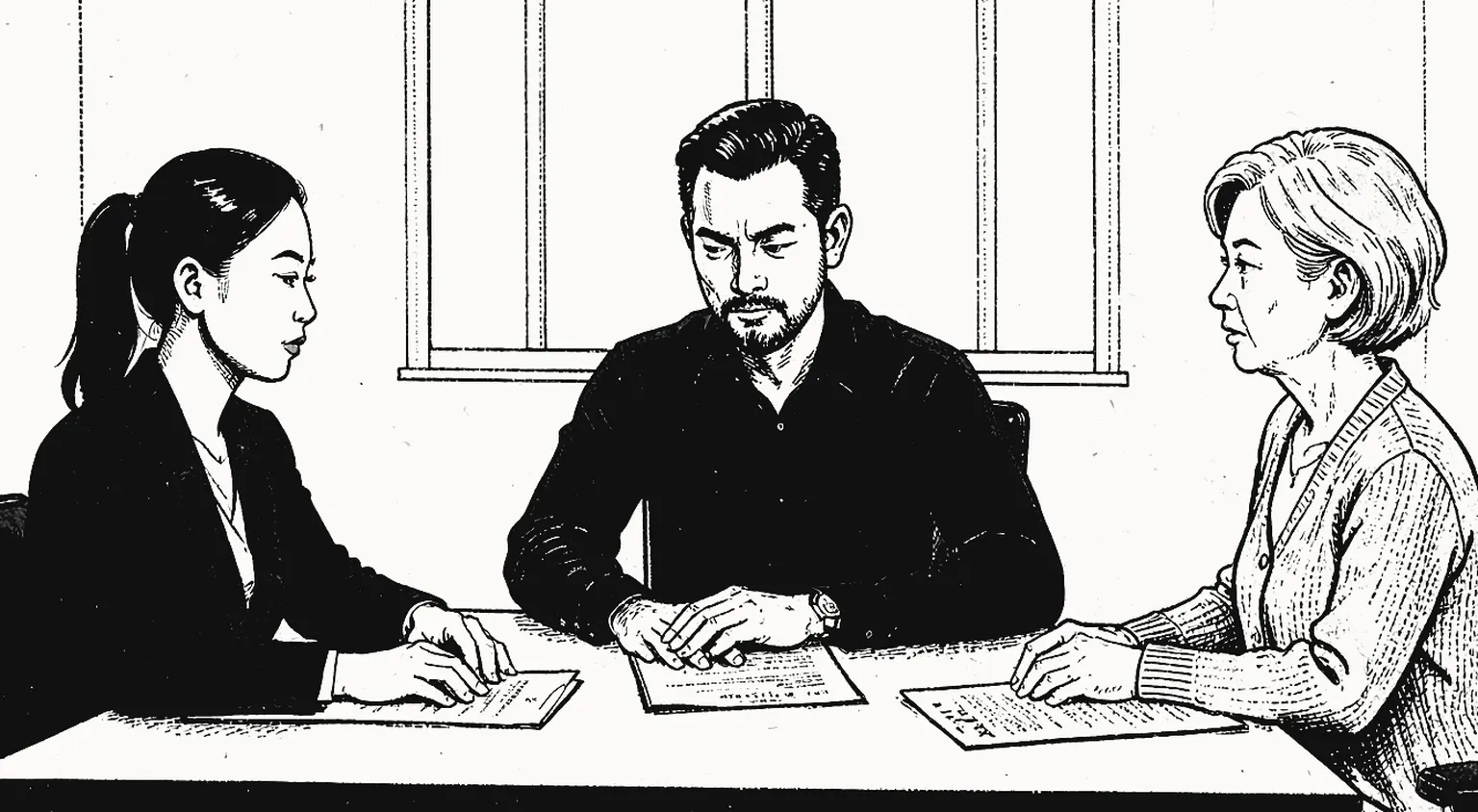
Nat has just finished her update. Her boss leans back and says, loud enough for the whole room, "Honestly, this is the third time the numbers are wrong. I do not know what you are doing over there." Eight people look at their laptops. Nat feels her face go hot and her mind go blank.
Here is the thing most people never say out loud: a public attack is rarely about your numbers. It is a test of the room's seating chart. Everyone is watching to see whether you flinch. You will see this in almost every office, and it is mostly about the next ten seconds. Whoever stays steady usually comes out of the room with more respect than before, whether or not the attack was fair.
This guide gives you a plan for the moment, for the rest of the meeting, and for the day after. It trains Calm Is Power first and Name the Feeling second.
The short answer
- Slow down the body. Breathe out, drop your shoulders, lower your voice.
- Pause before you speak. Two seconds feels long to you and normal to everyone else.
- Answer the content, not the tone. One calm sentence, or a how or what question.
- Name the feeling if it helps, in a neutral way.
- Follow up in private and in writing. Settle the pattern outside the room.
DiagramThe calm response
Five steps, in order. The first two happen inside your own body, before you say a word.
Why you freeze (and what to do about it)
When someone attacks you in public, your brain reads it as a threat to your place in the group. Steve Peters, in The Chimp Paradox, calls the fast, emotional part of the mind the Chimp. He says it reacts before your logical side, the Human, has a chance. We should say plainly that the brain model is his picture, not settled science. But as a description of what it feels like, it fits: heat, a racing heart, the urge to snap or to shrink.
Gaetan Meurisse, in Master Your Emotions, says something that helps in the same moment. We get defensive when someone threatens our story about who we are. That is why a remark about "wrong numbers" can feel like "you are incompetent." If you see the difference between the event and the story, you can respond to the event.
What the books agree on, in practice: the first move is for the body, not the words.
- Breathe out slowly, longer than you breathe in.
- Put both feet flat on the floor.
- Slow your speech down on purpose. Fast speech tells people you feel cornered.
You are not trying to feel nothing. You are trying to act from advantage, not from emotion.
Step 1: Pause
The pause is your most powerful tool, and it costs nothing.
After the attack, count to two before you speak. Look at the person. Do not smile, and do not frown. Keep your face still. This reads as control. A fast reply, even a good one, reads as reaction.
This is the same instinct as Law 4 in The 48 Laws of Power, say less than necessary. Greene says power grows with silence and that words give away your hand. I think he overstates it in general, but in this moment he is right. The calmest person sets the temperature of the room. My rule: never argue in public with someone who can hurt you in private.
Step 2: Answer the content, not the tone
An attack usually has two parts: a statement that may be partly true, and a tone meant to hurt. Reply only to the statement.
You have three clean options.
Agree with the true part. "You are right that the Q2 figure was off. I have corrected it and the new version is in the folder." This removes the fuel. It is hard to keep attacking someone who agrees with the fair part.
Ask a calibrated question. Chris Voss, in Never Split the Difference, suggests open questions that begin with "what" or "how". They make the other side think instead of push. For example: "What would you need to see to feel confident in these numbers?" or "How would you like me to handle this next time?"
Set a boundary on the setting. "I would like to get this right. Can we go through the details after the meeting so we do not use everyone's time?"
Step 3: Name the feeling (carefully)
Name the Feeling is the second lever here. In Voss's language this is a "label": you say the emotion you hear, in a neutral voice, then stay quiet. It does not mean arguing with the person. It means showing you have read the situation.
Use it in two directions.
Label the other person. "It sounds like you are worried about the client." The attacker is often under pressure of their own, and the label can drop the temperature fast.
Label yourself, lightly, in private. In Master Your Emotions, Meurisse suggests giving a feeling a plain name instead of fighting it. Silently say: "This is anger." "This is embarrassment." Naming it takes some of its charge away. That is his claim from his own method, so test it for yourself.
Step 4: Handle the rest of the meeting
After you answer, the meeting still goes on. This part matters because people remember how you carried yourself in the next ten minutes.
- Do not over-explain. One answer is enough.
- Keep your voice at the same speed and level as before.
- Do not look around for allies. It signals you need rescue.
- If you speak again, add something useful. That shows your attention is on the work, not the hit.
If you feel your emotions rising again, take a sip of water, write a note, or ask a question. All of these buy you time without looking weak.
Step 5: After the meeting
The meeting is over. Now deal with the pattern, not the moment.
- Cool down first. Walk for five minutes. Do not send an email while hot.
- Sort the attack. Was it partly fair? Then fix that part. Was it an unfair habit? Then plan a conversation.
- Follow up in writing if it matters. A short, neutral note: "Following today's meeting, here is the corrected sheet and the legal approval."
- Talk in private. Ask for ten minutes. Say what you saw and what you want.
This is Go Around, Not Through in a small form. You do not fight the pattern head-on in public. You change it through a private, reasonable request.
Your callWhat would you do?
In a team meeting, a colleague says sharply, "Your numbers are wrong and you know it." Everyone looks at you. Your face is hot.
Weaker move. Lever 1 is missing. You act on the heat, and the room remembers your tone, not your point.
Strongest move. Lever 1 and Lever 4. You stay steady, answer the content and not the tone, and the other person has to be specific.
Weaker move. Lever 1 is not the same as silence. Freezing hands the room to the attacker, and you give up your side of the facts.
Two more scenarios
The dark version
Drill
The clean version
Next, read When Someone Takes Credit for Your Work.
Questions people ask
What do I say when someone attacks me in a meeting?
Pause, then answer the content in one calm sentence, or ask a how or what question. For example: 'What would a good result look like for you here?' Do not defend your character in the room.
Should I fight back in public?
Rarely. A sharp reply gives the attacker what they wanted, a reaction. A calm, short answer makes the attack look worse than it was. Deal with the pattern in private.
What if the attacker is my boss?
Stay even and brief in the room, never argue the point there, and ask for a private follow-up. Bosses test how you act under pressure. Calm and clear counts in your favour.
Sources: Never Split the Difference; Master Your Emotions; The Chimp Paradox; The 48 Laws of Power. Ideas summarised in our own words.
This page trains Lever 1: Calm Is Power. Stay calm. Act on advantage, never on emotion.
Also: Name the Feeling.
Next lever: Know Your End First
Find your weakest lever
12 questions, 2 minutes. You get your type and the one lever to train first.
Take the Influence Score